


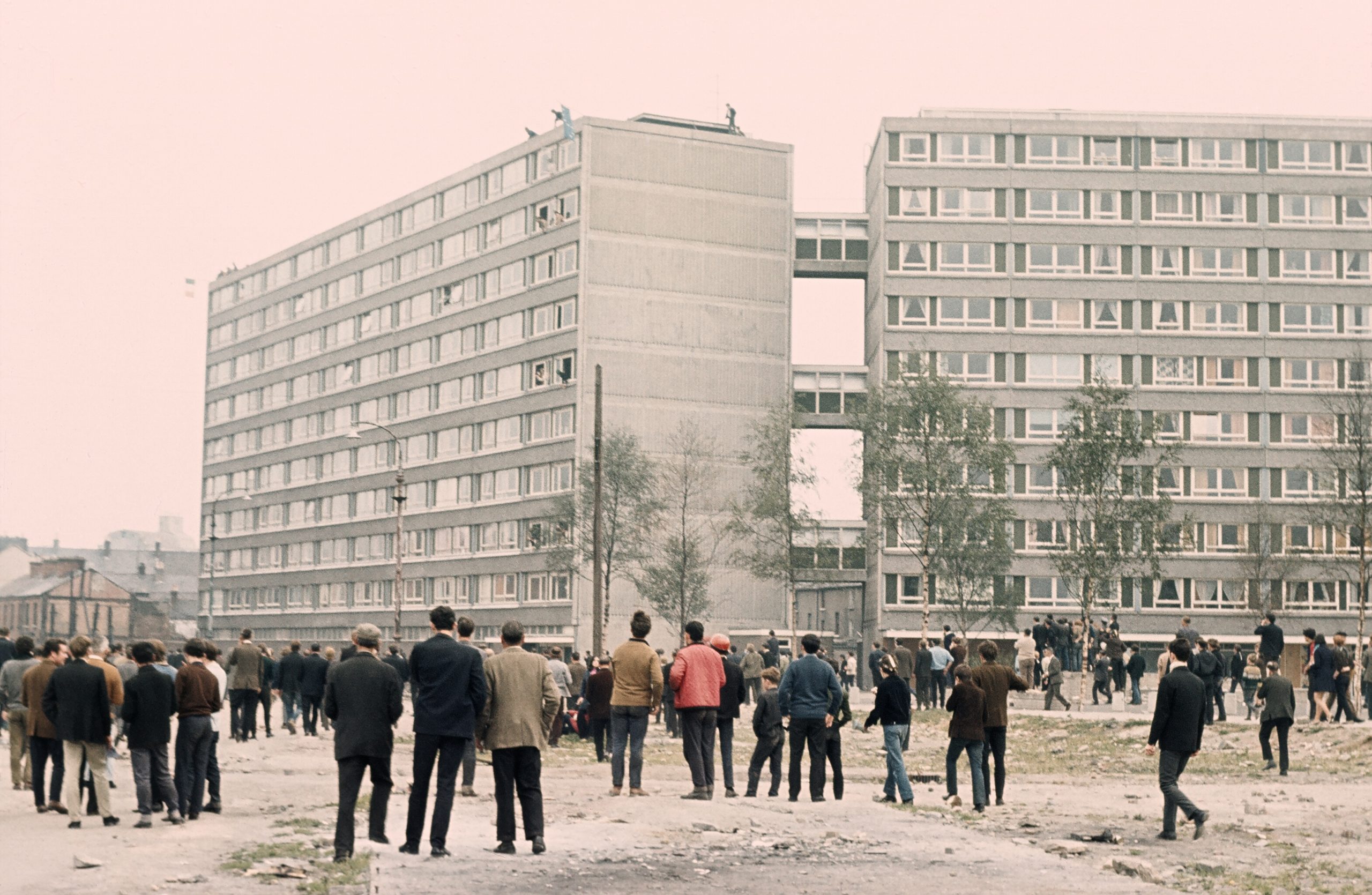
Scroll through the timeline below to discover the Free Derry Story. Click on “Continue this topic” to dive deeper into that area of the story.
-
Introduction
The civil rights movement in Ireland has its deepest roots in Derry. It was here on 5 October 1968 that the issue of civil rights in the north first came to the attention of the world when the police attacked a peaceful demonstration in Duke Street.

It was here that the first no go area was declared in January 1969, when the defiant slogan ‘You Are Now Entering Free Derry’ appeared on a gable wall in the Bogside.
It was here on 30 January 1972, Bloody Sunday, that 14 unarmed demonstrators were killed and 17 others injured by the British Army in the streets around this building.
By boldly taking on the might of the state, an oppressed people were demanding a different world where justice, equality and freedom were the entitlement of all. In this museum and archive rests part of their legacy. Their epitaph is the continuing struggle for democracy. This museum is dedicated to all who have struggled and suffered for civil rights everywhere, and who will do so in the future. -
A Community Without
The history of the Bogside has been characterised by the relationship between two communities – one within the walls, safe, secure and powerful; one without, powerless, dispossessed and oppressed.

The history of the Bogside has been characterised by the relationship between two communities – one within the walls, safe, secure and powerful; one without, powerless, dispossessed and oppressed.
The influx of migrants throughout the 18th century, which increased during and after the great famine of the 1840s, created a Catholic majority in Derry. Since Catholics were forbidden from living within the walls most settled in the Bogside.
By the end of the 19th century, Catholics had a clear voting majority in Derry but no corresponding political power.
Tensions rose across Ireland during the 1919-21 War of Independence. In the spring and summer of 1920, 40 people were killed in the city in clashes between republicans and an alliance of loyalists and British forces.
When the Government of Ireland Act was passed in 1920, and partition became a reality in 1921, nationalist Derry felt abandoned, a very reluctant part of the north.
-
After Partition
After partition, the Unionist Party set about creating “a Protestant state for a Protestant people” – built on a “foundation of sectarian discrimination, biased administration and a barrage of totalitarian legislation, which both protected unionism and instilled a deep sense of social injustice in the non-unionist population.”

After partition, the Unionist Party set about creating “a Protestant state for a Protestant people” – built on a “foundation of sectarian discrimination, biased administration and a barrage of totalitarian legislation, which both protected unionism and instilled a deep sense of social injustice in the non-unionist population.” (Northern Ireland Civil Rights Association, 1978.)
Unionist leaders ran the north on the basis that to give something to Catholics was to take it away from Protestants. Working-class Protestants were urged to see equality for Catholics as a threat to their position. Catholics were virtually excluded from government jobs while private employers were urged to employ only “loyal men and women.”
No effective opposition to the Unionist government was permitted. The Special Powers Act and the police and the Special Constabularies – essentially, militant unionists, armed and in uniform – were all used as sectarian political tools. At one point, there was one police officer for every two Catholic families in the north.
Over the 50 years of Stormont rule, successive British governments, which retained ultimate authority over the north, including over Stormont, operated a policy of “out of sight out of mind.”
-
Civil Rights
In the 1950s oppressed people around the world began to demand civil rights and change.
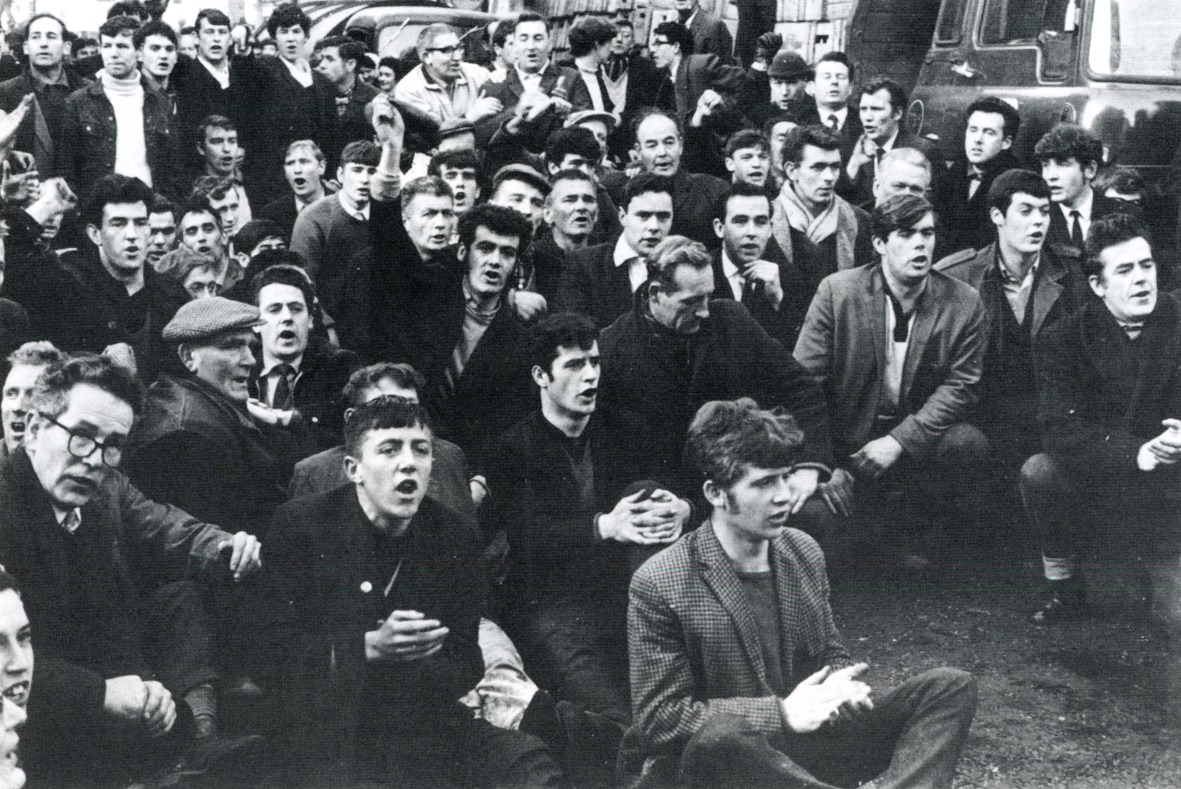
Increasingly alert to events in the wider world, Derry noted the US, South African and other struggles for justice, and by the mid-1960s small groups in Derry and elsewhere were taking to the streets to demand action on housing, jobs and votes.
Some unionist politicians were making promises of change, but opposition from within their own ranks frustrated this and civil rights protests spread. The Northern Ireland Civil Rights Association (NICRA) was formed to coordinate actions.
In the USA, in 1955, Rosa Parks refused to sit at the back of a bus in Montgomery, Alabama. In 1957, the National Guard had to escort nine black schoolchildren past racist protestors in Little Rock, Arkansas. In March 1960, 60 black anti-apartheid protestors were shot dead in Sharpeville, South Africa.
In August 1963, 200,000 civil rights supporters gathered in Washington to hear Martin Luther King proclaim “I have a dream,” and Bob Dylan unveil “Only a pawn in their game,” highlighting the manipulation of the white poor by racist politicians.
And in Dungannon in County Tyrone in 1963, housing protestors gathered outside a council meeting carrying placards: “If Our Religion Is Against Us Ship Us To Little Rock.” The demonstration led to the formation of the Campaign for Social Justice, the north’s first civil rights organisation.
“We Shall Overcome” became the anthem of the civil rights movement in Ireland.
-
Duke Street
A march was planned for Derry in October 1968. Despite the march being banned by the Unionist government, the protestors went ahead.

On 5 October the marchers were confronted by police in Duke Street, and were physically battered off the streets. By chance, a single television cameraman had filmed the incident, and the truth of unionist abuse of power was splashed onto television screens across the world.
There was an upsurge in support for the civil rights protests, and a concentrated series of marches in October and November led to a few reforms from the Unionist government. But it was too little and too late. The civic atmosphere in the north of Ireland had changed forever.
-
Free Derry
In early January 1969, as police attacked the Bogside, the slogan ‘You Are Now Entering Free Derry’ was first written on the gable wall. It was inspired by the sit-in protests in Berkeley University, California.

Barricades were erected and the police, for the most part, repelled. Radio Free Derry began to broadcast from the Rossville Street Flats. The concept of Free Derry was born.
In April 1969 Sammy Devenny was attacked by the RUC in his home. He died of his injuries on 17 July and became the first victim of this stage of the conflict in the city. His death pushed the Bogside to the edge.
-
Battle of the Bogside
On 12 August, thousands of Apprentice Boys prepared to march through a Derry seething with anxiety and discontent. As the march passed the Bogside, it was greeted by jeering and stone throwing. The police, backed by loyalists, tried to force the protesters back.

Unlike during previous incursions, Bogsiders were ready. Existing barricades were strengthened and new ones erected. Stockpiles of petrol bombs and stones were brought forward.
Over three days and two nights of fighting, the Bogside held the barricades. The area had effectively seceded from British rule.
On 14 August, the Bogsiders pushed an exhausted police back towards the city centre. At the same time, B Specials could be seen mobilising behind police lines.
At 4.00pm on 14 August, as Derry prepared for confrontation between the Bogside and the B Specials, soldiers of the Prince of Wales Regiment were deployed around the area. Their initial guarded welcome would not last for long.
-
Towards War
Disagreement on how to relate to a dramatically changed situation had led to the Republican Movement splitting in December 1969 into the ‘Officials’ (OIRA) and ‘Provisionals’ (PIRA). Both groups were making ready for an armed campaign.

By April 1970, when republicans commemorated the Easter Rising, clashes between young people and the British Army had become a daily occurrence.
By the end of July 1971, nine people had died in Free Derry, including the first British soldier killed in the city, and the first unarmed civilians shot by the British Army.
Support for republicanism among northern Catholics generally was greater than it had been for decades. Recruits were relatively easily found among the ranks of teenage rioters.
-
Internment
As violence spiralled, the British Government, pressed by unionist leaders at Stormont, introduced internment (imprisonment without trial) in August 1971. The measure had been used against republicans in every decade since the foundation of the state.

Internment enraged nationalist Derry. Barricades were again erected and Free Derry resurrected. Armed IRA patrols appeared openly. Within hours, six British soldiers were wounded. Across the north, 17 people were killed in the 48 hours following internment, including the first British soldier shot dead in Derry by the IRA. Around 7,000 people fled their homes.
Internment united opinion in Free Derry in a way not seen since 1969. Angry protests became an everyday occurrence. A campaign of civil disobedience was undertaken. More than 130 non-unionist councillors withdrew from district councils. A rent and rates strike was launched.
-
Bloody Sunday
British and unionist politicians fumed at the existence of Free Derry. But internment had stiffened the community’s resolve. An anti-internment march was planned for 30 January 1972.

British and unionist politicians fumed at the existence of Free Derry. But internment had stiffened the community’s resolve. An anti-internment march was planned for 30 January 1972.
Fifteen thousand people gathered in Creggan on a bright, crisp winter’s day. There were rumours that paratroopers were amongst the heavy British Army presence in town, but the mood was cheerful. A peaceful day (by Derry standards), was expected.
The march began shortly after 3pm. A little over an hour later, 13 men and boys lay dead – innocent and unarmed marchers shot down by members of the British Army’s Parachute Regiment; a 14th man died later from his wounds. Seventeen others, including two women, were injured. Some were shot in the back as they tried to flee. One victim was shot a second time and killed as he lay injured, others were shot as they tried to help the injured and dying.
-
Motorman
Bloody Sunday failed in its objective to terrorise the no-go area. Stormont fell in March and direct-rule from London was re-instated.
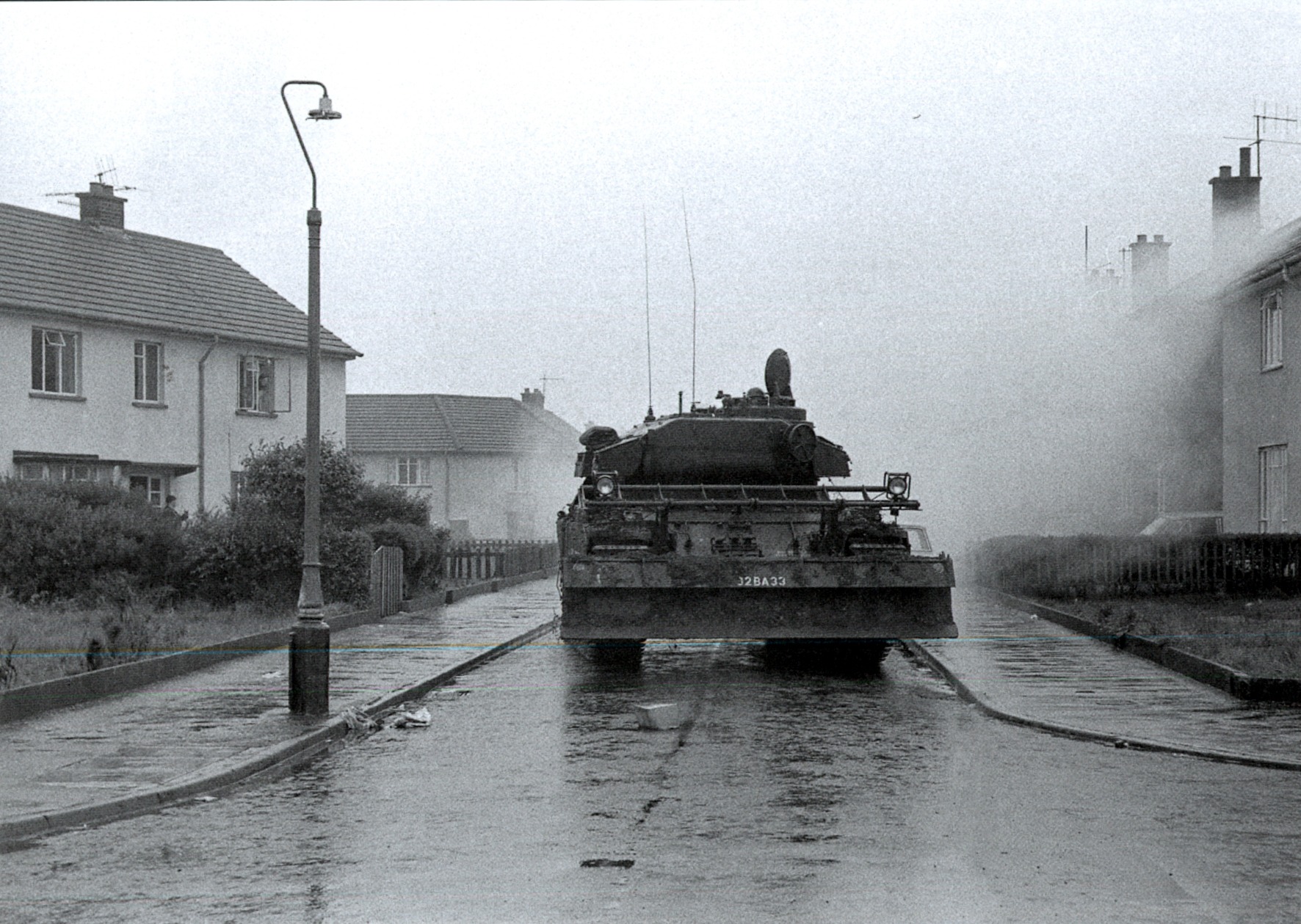
Free Derry remained. Support for republicanism grew. The conflict continued to escalate. In six months after 30 January, 15 people were killed in the Free Derry area.
In July, the British Army began ‘Operation Motorman’ to smash Free Derry and other no go-areas in the north of Ireland: 21,000 troops, supported by tanks and bulldozers, invaded nationalist working class areas.
The IRA had been forewarned that they would be facing an overwhelming military force, and had quietly left the no-go areas, offering no resistance. By daylight Free Derry was under armed occupation. The British Army set up camps around the area, and for the next 22 years, Free Derry was one of the most militarised areas in western Europe.
-
The Long War
Free Derry as a physical entity ended with Operation Motorman, and this area suffered inordinately in the decades of armed conflict that followed.

The death and injury rate here throughout the 1970s, 1980s and into the 1990s was high as the PIRA and the British Army fought a long war of attrition.
But the spirit of Free Derry lived on in the stubborn independence of its people. The lessons of self-reliance learned during the years of Stormont repression, which were first evidenced in the emergence of the early civil rights groups, remained apparent in the strength of the community sector here and in how the people of this area continued to look to themselves to look after their own interests. This was, and is, especially important since it is still one of the most economically and socially deprived areas in the north of Ireland.
And just as Free Derry was central to the emergence of the conflict, so too was it central to the political process which ended it, with early talks between key figures taking place here in the late 1980s and early 1990s.
-
Bloody Sunday 1973 – 2010
The struggle for justice for the victims of Bloody Sunday continued throughout the years of conflict and beyond. An annual commemoration march was held every year from 1973, retracing the steps of the original marchers.
A new inquiry into Bloody Sunday was announced in 1998, and published its report 12 years later, on 15 June 2010, concluding that all of the dead and wounded were innocent. Although the report was greeted with soaring relief and applause, there was some dismay that all blame was ascribed to a single British officer, Derek Wilford, and a number of low-ranked soldiers. The Tribunal had followed a long tradition in averting its eyes from the possible role of the military and political elite.
The report also found that one of the Bloody Sunday victims, 17-year-old Gerald Donaghey, was ‘probably’ carrying nail bombs when he was shot, a finding that went against all the available evidence.
Nonetheless, the British admission of innocence was a golden success for the community and the families of the victims, over seemingly impossible odds. There was a sense of relief, and the lifting of a darkness over the city of Derry.
Bloody Sunday had wounded Derry deeply. We may hope that our city has now begun to bind up those wounds.
A really beautifully thought-out museum, deeply moving and thought provoking, we as a family learnt so much.
Michael, Welwyn Garden City, England
A deeply emotional experience that makes you reflect on the struggles of the past.
TravelEnthusiast
Absolutely riveting. The museum gives an honest account of a tumultuous time in history.
HistoryFanatic
The most powerful museum I’ve visited in Ireland. So much history, pain, and resilience.
FionaK
A unique museum experience that leaves a lasting impact. Would highly recommend to anyone visiting Derry.
NomadicTales

All of the above content is available in various languages. Please visit our Translations page for more information and downloads.
Free Derry Lives
To discover more about life in Derry at this time you can visit our sister site Free Derry Lives and hear it from the people who lived through those times.


