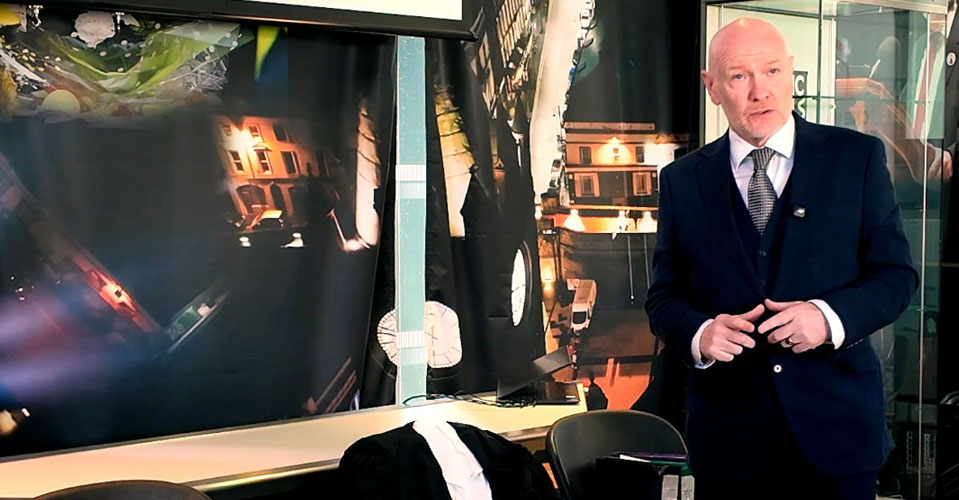
Article by Brian Dooley, Human Rights First
Family and friends of Gary English and Jim Brown gathered at the Museum of Free Derry on April 18 to mark the 45th anniversary of the teenagers’ deaths.
Gary was 19, Jim 18 in April 1981 when they were killed by a British army landrover in Derry. That Easter weekend of April 18/19, Maggie Thatcher was nearly two years via office, Ronald Reagan almost two months. Just over a week before, Bobby Sands had been elected as an MP from prison. He was to die a few weeks later.
Fifteen-year-old Paul Whitters from Derry lay on a life support having been shot in the head with a plastic bullet by an RUC constable. He also died shortly after.
Drawing heavily on a report into the deaths by the Pat Finucane Centre called Anatomy of a Cover Up, I presented a short account of what happened that Easter Sunday night when the two young men were killed, and how various state institutions have failed the families in presenting the truth.
That night of April 19, just after 6.45pm, two British army landrovers with soldiers from the Royal Anglian Regiment left Rosemount RUC barracks. The two armoured vehicles drove down Creggan Hill at speed towards the junction with Creggan Street, Marlborough Terrace and Infirmary Rd, where a group of people had gathered.
The driver was Lance Corporal Stephen Buzzard, and with him in the vehicle was Colour Sergeant Hugh Dalton Smith, who gave the order to drive through the junction.
Both Gary and Jim were struck by the lead ¾ ton military vehicle. It then reversed back up the hill and ran over Gary’s body. Both Jim and Gary were pronounced dead soon afterwards.
The state institutions – the British military, the RUC, the trial of the two soldiers, the coroner’s inquest and the Historical Enquiries team – all failed the families in providing the full truth.
Then soldiers’ claim that the jeep wasn’t speeding was contradicted by many eyewitnesses. After speaking to some who and been at the scene when it happened, Bishop Edward Daly said “it appears the army vehicle was driven at reckless speed… It seems to have been a stupid and cruel deed.”
The RUC classed the incident as a road traffic accident, and appointed a traffic cop, a uniformed sergeant, to lead the investigation.
Sergeant Bradley later said he made no interview notes when he spoke to the soldiers, and admitted he hadn’t seen crucial civilian eyewitness accounts before interviewing the soldiers.
No investigative team was created, the scene wasn’t carefully examined for evidence, and contradictions in statements weren’t put to the soldiers.
The driver, Corporal Buzzard was charged with causing the deaths of Gary and Jim through “reckless driving”. Sergeant Smith was charged with “aiding and abetting” the offences.
The four-day trial took place in January 1982 under Judge Brian Hutton, who had represented the Ministry of Defence at the Widgery Tribunal into Bloody Sunday, where he had sharply rebuked the Derry Coroner who described the shootings as “sheer unadulterated murder”.
Hutton directed the jury to disregard the reversing over Gary English’s body when deciding cause of death, based on the opinion of the state pathologist.
Both soldiers were found not guilty by majority verdict on all charges.
After intensive research and advocacy by Gary English’s family, an inquest was held the following year, 1983. Jørgen Dalgaard, a Danish independent expert in forensic pathology and a specialist in traffic cases, testified that Gary English’s fatal injuries could only be explained by the vehicle reversing over him. This contradicted the state pathologist evidence that Gary had been killed by the initial impact.
Despite this, the coroner concluded that Gary English’s “the fatal injury was inflicted from the initial impact, not the reversing over his body.”
Almost 30 years later, in 2012, the Historical Enquiries Team informed the family that the deaths of Gary and Charles English were to be investigated. In 2016 the English family were presented with what was described to them as draft document on the findings of the HET.
It not only made the mistake of referring to “Constable Gary English,” it also stated that “The HET believes that … a thorough investigation was undertaken” and that “The transcripts (from the trial) reflect a fair trial with an unbiased summing up”.
Each of the five institutions failed the truth, failed the community, failed the families, and failed Gary English and Jim Brown. Instead of accountability, we are left with a systemic failure, and an irrefutable Anatomy of a Coverup.
View Anatomy of a Cover-Up: The Rule of Law on Trial.