


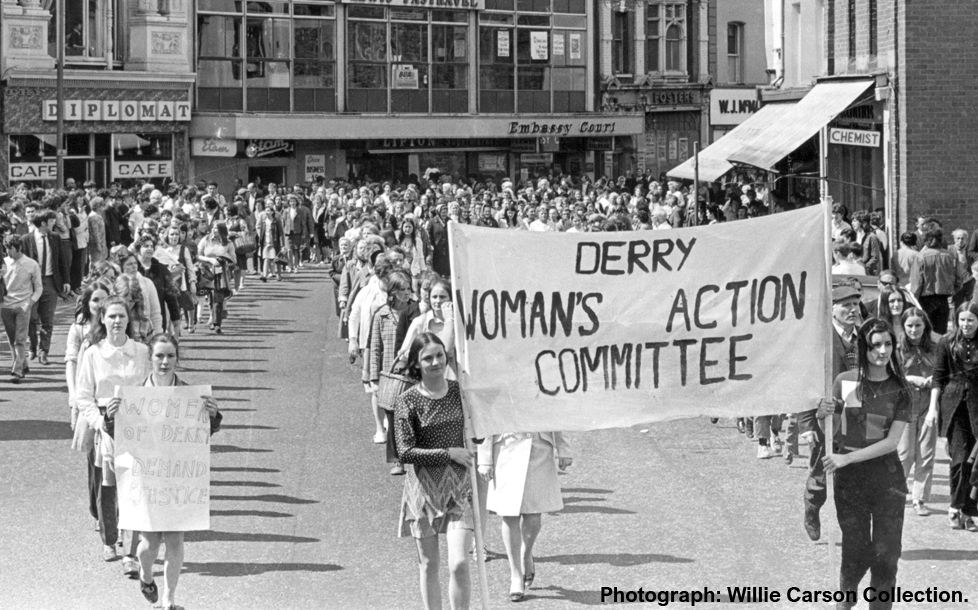
An oration for the late Roisin Barton, life-long community activist and mother of Bloody Sunday Trust board member, Colm.
It was an Irish American priest who many years ago wrote an article entitled ‘Consider the Women of Ireland’. We are gathered here today to pay tribute and to honour such a woman Roisin Keenan Barton, many of us just knew as Roisin Keenan.
We are sorrowful beyond words for the loss of this woman of Ireland, her courage, her strength, and her great dignity as a human being living through a time of great adversity.
Roisin was a daughter, a sister, a wife, a partner, a mother and grandmother and great grandmother and in all the many roles she fulfilled in her life she did so with humour and compassion and a lot of straight talking. Roisin never minced words.
Each of us in our own way will cherish the memories of Roisin but few of us will truly understand the immense debt that we owe her. She was of the generation that got off their knees and for the rest of her life she gave her energy and talents firstly to her family and to the cause of freedom and justice not just in Ireland but in the many countries of the world for she was truly an internationalist.
Her life and that of her family was never easy. Her father the late Sean Keenan spent many years in various prisons and prison ships though he was never convicted of any offence. Her Mother Nancy was also interned in the 1940s. In the past few months, Roisin, her sister Nora and son Colm launched the ‘Forgotten Woman’ exhibition to honour the many women imprisoned during the 1940’s and written out of history. Though not well enough to attend the launch herself, nonetheless she was delighted that the launch was packed out. It was a step forward in researching the hidden and often unacknowledged history of women.
The early days of what has become known as the troubles were hard times for the Nationalist community. The Keenan family living in St Columb’s Wells in the Bogside knew at first hand the tragedy of those years. The injustice of internment without trial affected her father Sean, and her brothers Sean and Seamus . All this weighed heavily on the newly married Roisin. The death of her brother Colm in 1972 added to her grief. But Roisin was made of stern stuff as we all witnessed during the past months of her ill health for she was that stubborn human being, stoic, who would not accept that what was happening to her family and to the community, was right. She had grown up in the hard times where the washing ritual of a tin bath on a Saturday night was the norm and overcrowding in housing had produced an epidemic of TB a deadly lung disease which sent many of her community to an early grave. But Roisin could see change on the horizon. Many of us here today will have had personal experience of her courage, her intelligence, and her determination to bring about that change.
Her early political activism was directed towards protests for better housing conditions and at the injustice of internment. She, who knew such personal grief wept with the community march against internment which ended with the deaths of thirteen people in what the world now knows as Bloody Sunday.
It was a day that changed life forever for the people of Derry. In the years to come hundreds of young people ended up in the Norths infamous prison the H Blocks of Long Kesh. Roisin even though pregnant with her fifth child regularly visited prisoners, and helped with fund raising efforts to support their relatives
She moved to the Brandywell area of the City which she loved and became involved in the Gasyard Feile. During those years her youngest son Padraig was killed in a road accident. It was blow that a lesser person would not survive but Roisin now suffering a lot of physical illness faced it down and continued her life’s work of bringing change and instilling a sense of justice and equality in this community of the Bogside she loved so well.
She became involved in Dove House, a Community Resource Centre in the Bogside where she was instrumental in setting up empowerment projects for women. She later was invited to join the Management Committee and she shaped the great Centre it is today.
Wherever there was injustice, whether it was womens rights or the denial of rights to Palestinians Roisin got involved. She never missed a protest.
She was an avid reader and helped start a local book club in the area. There was plenty of good discussion and great craic on book club night.
Roisin never accepted the status quo, She wanted a better Ireland, and a better world, for her own children, whom she loved deeply and who brought her great joy. She will be sorely missed by Peter, Liam, Sean, Colm, her only daughter Aine, wee Seamas and her beloved Padraig. She saw the future in the grandchildren she loved. To them all I offer my sincere sympathy.
Roisin had a great life, she had a hard life. It was full of both love and hardship, but it was always the love, the desire for a better Ireland, her desire for justice and her desire for freedom that won out.
As we say goodbye to Roisin our hearts are sore and I know that no words of mine can ease them. But as we leave here today, as we leave Roisin in the company of Old Jimmy Keenan and with her beloved Padraig, I do so in the knowledge that my life, and the lives of so many people have been the better for the courage of this tiny woman, my friend and a true friend of the people of the Bogside. We will never see the likes of Roisin again.
Oration by Mary Nelis


